Interview
Five questions with Jeremy Leonard, Managing Director, Global Industry Services at Oxford Economics
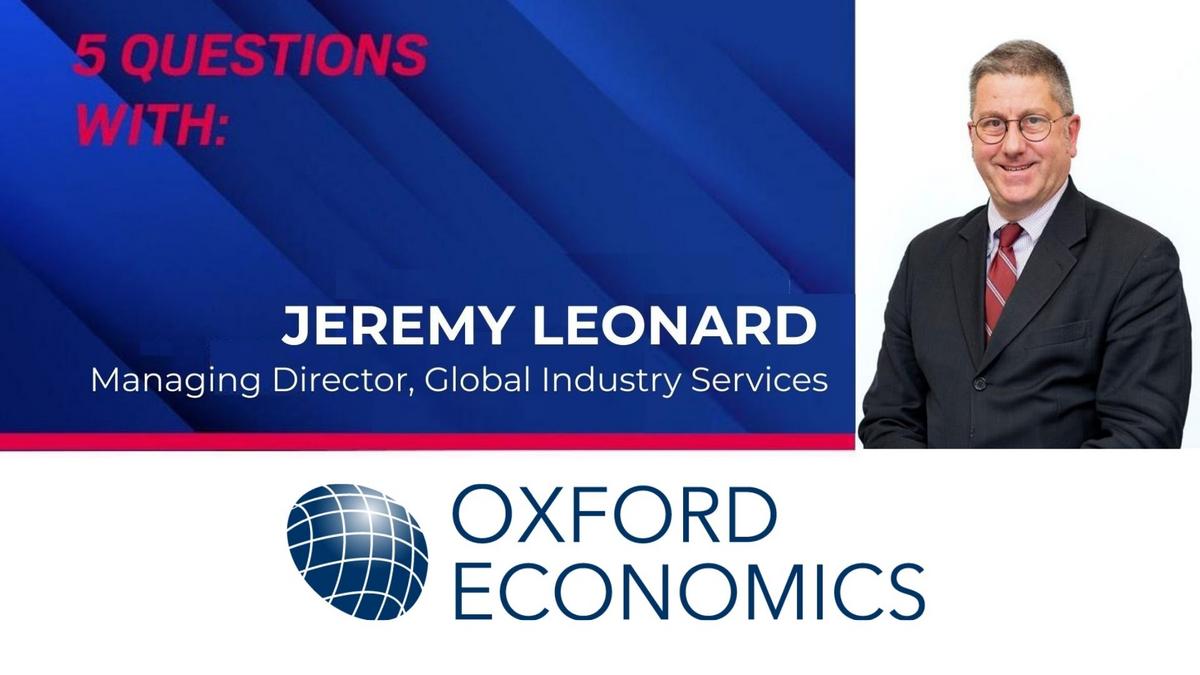
We spoke with Jeremy Leonard, Managing Director, Global Industry Services at Oxford Economics, about his international career and the key forces shaping the global economy in 2026. Drawing on over 30 years of experience across public policy, consulting and economic forecasting, he shares his perspective on today’s most pressing economic and geopolitical risks.
From protectionism and the AI boom to fiscal pressures in Europe and the outlook for France and the UK, Jeremy offers clear, strategic insights for business leaders navigating an increasingly uncertain global landscape.
Jeremy, could you tell us about your career journey and the key experiences that have shaped your work, particularly through working in different countries?
Even though I have led a forecasting team within Oxford Economics for nearly 14 years, my career trajectory started very far from that in the realm of public policy analysis. A short stint in my hometown of Washington DC as an eager young analyst at a business-oriented think tank gave way to economics graduate study in Montreal, a city that I feel in love with so much that I settled there, became a Canadian citizen, and started a family with a French born-and-bred wife (and hence a French citizen by marriage). Then the old country beckoned us, and we settled in London just in time for the 2012 Olympics.
In Montreal I spent more than a decade running my own consulting firm, which really hones one’s skills in listening carefully to understand pain points and trying to articulate solutions to address them. Working in Quebec taught me about the importance of cultural differences and how to bridge them by listening to and understanding different points of view.
Cultures differ, but I’ve learned through my career in the US, Canada and the UK working with clients across the globe that the common denominator of what people fundamentally seek is to make sense of a world that is complicated and overflowing with data and information. In all my roles, whether they be public policy analysis or economic forecasting, my clients simply want to understand the essential story. What matters and what doesn’t. That’s what I’ve striven to help them do over the past 30+ years.
How would you introduce Oxford Economics to our members?
Oxford Economics has grown into one of the world’s largest economic forecasting and advisory firms since its founding 45 years ago, with over 750 employees in nearly two dozen offices worldwide. Much of that growth has occurred during my tenure (though I certainly wouldn’t take full credit for it!) — we were less than one-tenth of our current size when I arrived for my first day of work. We continue to grow by taking market share from our competitors in traditional economic forecasting and expanding our service offering to penetrate new markets.
Our meteoric growth rests on three core pillars. First, our unique integrated suite of forecasting models provides a comprehensive and consistent view of the global economic outlook across more than 200 countries, 100 sectors, and 8,000 cities and subnational regions, allowing powerful scenario analysis under alternative economic assumptions. Second, our longstanding links to Oxford University (which date to our founding) help us develop cutting-edge techniques that unlock the power of economics to address a wide range of questions ranging from strategic planning to scenarios and risk assessment to business location decisions with evidence-based independent analysis. And third, we retain our culture as a “large small business” that combines comprehensive scope of analysis with agility and second-to-none client support. The founder of the company John Walker remains actively involved in the strategic direction of the business and is a frequent and much-loved visitor to our offices around the world. Our Executive Chairman Adrian Cooper has been with us for 32 years (29 of them as CEO), and Innes McFee has recently taken the reins as CEO to guide us on our next phase of growth after nearly a decade of skilfully managing our flagship macroeconomic forecasting business. This continuity of leadership has allowed a culture of excellence, collegiality and rigour to reinforce itself over the years.
Oxford Economics also has a long history in France. Our Paris office was one of the first established outside the UK nearly two decades ago by my colleague and good friend Pierre Delage, who continues to lead it. We count half of the CAC-40 in our book of business, with hundreds of other clients à travers l’Hexagone.
From your perspective, what major economic, geopolitical or sector trends should business leaders have firmly on their radar for 2026?
We see three interrelated economic trends underpinning the economic outlook this year.
First, the creeping tide of protectionism and associated uncertainty will likely continue. But businesses are increasingly looking past the tariff “noise” and getting on with planning for an uncertain and volatile trade policy environment. Protectionism and nationalism are not confined to the US — we see similar trends in Europe and elsewhere, which is why we think that recent “deglobalisation” tendencies will outlive the Trump administration.
Second, the AI boom is masking the adverse effects of tariffs, especially in the US, which continues to generate economic growth well ahead of the rest of the developed world. But this growth is very narrowly focused — driven by the direct investment in datacentres that is growing at a meteoric rate and the associated increase in equity values that is driving strong consumer spending at the upper end of the income distribution.
Third, fiscal and monetary policy are playing important but contrasting roles in the outlook. On the fiscal side, some countries (including the UK and France) are facing a budget crunch which requires a focus on debt reduction and consolidation, while others (including the US, Germany and China) are spending more freely. On the monetary front, central banks in the developed world have lowered the short-term interest rates they control directly as inflation has fallen, but the longer-term rates that matter for investment, construction activity and automotive demand have remained stubbornly high, partly due to worries about fiscal sustainability. As a result, the potency of monetary policy has become more muted relative to the past.
China’s fiscal expansion merits special attention. Its new five-year plan is straight out of a time-honoured playbook — robust promotion of industrial activity and exports with strength of the domestic economy put on the back burner. The difference today is that the targeted sectors are further downstream in value chains than in the past (such as electric vehicles, solar PVs and associated clean-energy technologies). This is accentuating global overcapacity, and US tariffs against China are creating headaches for European manufacturers who face, on top of high energy costs, additional lower-cost Chinese products penetrating their markets.
What are the main questions, needs and concerns you are currently hearing from the companies you work with?
From our latest quarterly Global Risk Survey released in February 2026, geopolitical concerns are top of mind amongst our clients. Greenland ranked as the top near-term concern (though President Trump’s walkback may allay those fears), while almost as many respondents highlight China-Taiwan tensions as a very significant risk. Middle East worries have also risen sharply in the wake of protests in Iran, with the region now cited by more than a quarter of respondents.
Perhaps surprisingly, fears over the global impact of US trade policy have declined and, overall, businesses do not expect any marked change in the prospects for global growth on this basis. But this is consistent with my conversations with clients regarding the need to look past the tariff “noise” and get on with it.
Our clients see a lot of upside risks in the AI space, which is consistent with our baseline view that the current boom still has a lot of room to run. Part of this is related to the economic activity generated by the construction of datacentres and associated power generation and distribution infrastructure to support it, but part of it is the longer-term potential for big productivity gains. At the same time, there are lingering worries that we might see a repeat of the dot-com boom and bust which, if it came to pass, would have a big adverse impact in the US and Asia in the short term.
It's worth highlighting the legitimate worries about industrial competitiveness in Europe, which is a recurrent subject of conversation in my travels around the Continent. High energy prices and increasing competition from China have put immense pressure on flagship industries such as chemicals, automotive, and machinery, and policy makers need to respond vigorously.
Looking ahead to 2026, how do you assess the outlook for the French and UK economies, especially for industries operating across both markets?
There’s no way to skate around the reality that 2026 is going to be a tough year for many European economies, and France and the UK are no exception. Both economies are expected to expand less than 1% this year. All the factors that I mentioned earlier will play to the detriment of growth, and this is magnified by political uncertainty on either side of the Channel. While the source of the uncertainty differs, its economic consequences are the same — hesitation to invest and hire on the part of businesses, and hesitation to spend on the part of households.
That said, it’s important not to overlook pockets of strength. The AI boom is heavily centred on the US, but it is generating robust demand across not only tech value chains, but power generation and electrical equipment as well, and numerous French and British companies such as Schneider Electric and Rolls Royce are well-positioned to capture it. In addition, travel and tourism is enjoying a resurgence in Europe — indeed the fastest-growing economies are those that are heavily tourism-oriented, such as Spain and Greece. We are forecasting tourism spending of well over £200bn in both France and the UK this year, a 3%-to-5% increase from 2025, which itself saw near-double digit growth.
And, of course, further out there is the prospect of significantly higher defence spending in Europe – we reckon it will be in excess of an additional £100bn spread over the next few years. Both France and the UK have long had competitive strengths in these markets and are likely to be called upon to help rebuild Europe’s home-grown defence and security capabilities.
Oxford Economics is the world's leading independent economic advisory firm. Covering over 200 countries, 100 industrial sectors and 8,000 cities and regions. We provide insights and solutions that empower clients to make informed decisions faster in an increasingly complex and uncertain world.